Nancy was honored at the fire day and honoring ceremony held at the Southern Humboldt Community Park (Roatary/ISF “All fired up”) on 12/8/2018.
This is a transcript of her spontaneous speech.
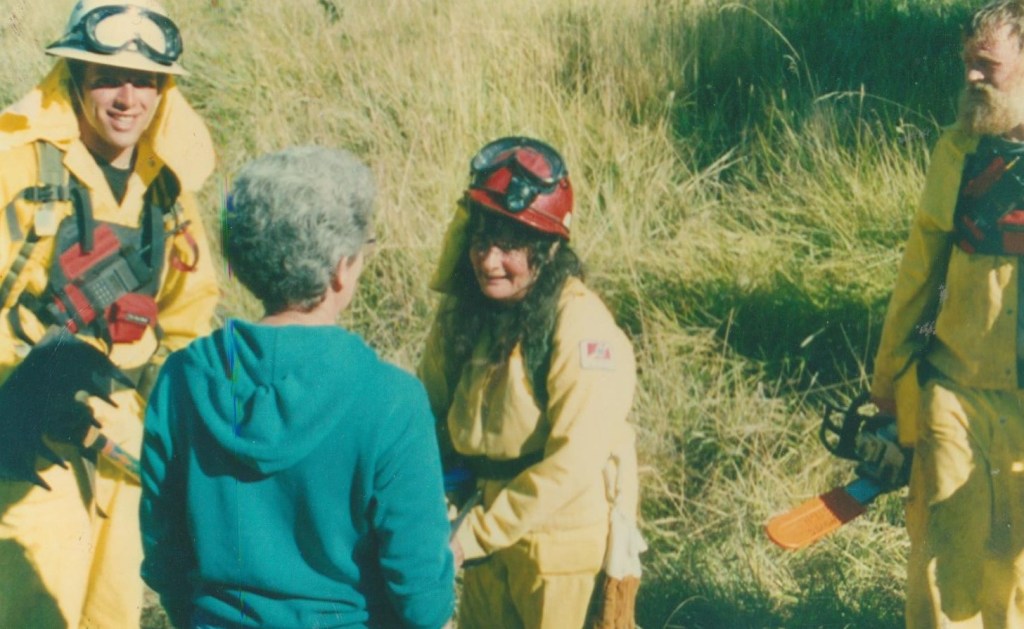
Andy Barnett: Nancy would like to say a few words. Come on, Nancy. Don’t be shy now, Nancy.
Nancy Peregrine: Well, I am shy, but I just have to say that nobody does this work alone, and that it’s really a team effort all the way and we all depend on each other for our safety and we train each other, and so, I feel honored to represent my fire department, but really it’s all of you and I see a bunch of you here – and I just, I better keep talking or I’ll cry because these people are so fine – I mean in the worst conditions they come out and respond to whatever condition it is.
But I have to say I do have the historical perspective, because there were no communities around here in the hills in those days when I moved here. I think I was the first one that moved here from the back-to-the-land people. Betcha I can beat any of you. [laughter] But I saw you all come and going. So, we’ve had people come and go. People have passed away or moved away and so it’s all changing as you have noticed more and more of us are passing away. And I just turned 73 and I see a lot of people passing away that are younger than me, so who knows how long I’ll be around. So my own position has evolved in my fire department from being the only person in it, basically. People used to come to my house because I had the only 4-wheel drive in Whale Gulch – and have me pull them out when they drove off the road and I would do it all by myself. So that’s how I learned the dynamics of chains and come-alongs. [much laughter from the audience] Anyway, and twice I was the only one that showed up for roof fires, and so, lo and behold – I got on the roofs and put out the fire all by myself. [crowd long applause] But anyway . . .
Now I’m pretty happy to be what I call the administrator – that’s sort of behind the scenes, and I can just – I keep on my radio 24/7 so I wake up, every call that any of you have. But I can filter it out and I can just go right back to sleep pretty much if it’s not us or our adjoining departments. But, I get right on the phone if it sounds like they’re, we’re going to be toned – and I start calling everybody: “Did you hear the call?” And that’s it’s: “Oh, no, what’s going on?”, then I know they didn’t have their pager on. And I sort of point it out to them too, because we all do have pagers. And start calling from who is closest to the firehouse, who’s closest to the incident. I mean there’s a lot that goes into my thinking for that, like get people there as soon as possible. And I’m glad to do that because I don’t have the physical fortitude to do what I used to do anymore. And so we have all these wonderful people now. Mike is our Chief now, and he’s in pretty good shape. [applause]
I could say about all the Chiefs, the people that stand up in their departments to be Chiefs, that it’s such a learning experience. It’s a learning curve because you learn skills about leadership, about training, about taking responsibility, about being clear with directions. There are so many aspects to being a Chief – and to everybody on the department for that matter. And I never felt that I was a Chief even when I sort of was, but I didn’t like, I didn’t feel comfortable to call myself a Chief. Because for one thing I don’t have a voice that’s commanding, and I don’t know if you have to – but I was in a situation where somebody, who was sort of not balanced mentally, went nuts just doing their own thing on a call – and I was yelling at him: “Do not cut that tree!”, because he was going to cut a tree onto an arcing line. And I could just see those chain of events, and he wouldn’t listen to me. And so I got megaphones after that thinking maybe this will make a difference I can really . . . but I just realized it’s
not for me to be the Chief, but I’m glad to be the assistant and the administrator. And again I just want to say for everybody that is involved with a fire department, and beyond that, the communities that support all of us. None of it would happen without everybody in these communities. Whenever we have a benefit, please support the fire departments because we’re counting on that money.
And I have to say that when I started with the fire department – actually I was just going to say a quick story – that during the Finley Creek fire [1973], from Ettersdurg to the ocean, officials came out to Four Corners, and I was there. And they said we’re going to start a backfire at Four Corners. [voice: That was the sheriff said that.] I couldn’t remember whether it was sheriff or . . . a uniform was a uniform to me then. [much laughter] It was six years developing a homestead, and I said, no you’re not. And I just – I felt like a mother hen, or something – I said you’re not setting a backfire here because there’s a whole community between here and the fire. And if we – because we didn’t show from the road. You know we were all tucked away in our little – on our skid roads and whatnot. And so, anyway, that was the beginning of the motivation to get involved. But being grass roots, I would never have joined a fire department probably if there’d already been a fire department there. And so I can see that for all of us, it was the opportunity of – there was a hole that needed to be filled and so we jumped up in and did it. And we didn’t have any skills. We’ve just learned on the fly, you know. And now it’s so much complex than it used to be, because all the regulations and upgrading all the equipment. We used to get everybody’s hand-me-downs, and now we’re trying some of the good stuff. Anyway, it’s changed quite a bit and there’s a lot more to keep up on. And it’s just an honor to be part of the fire community. [much applause] . . . sagittarian fire chiefs. Any Sagittarians around here? [voice: She trained two generations]
Andy Barnett: Let’s see was it, Sagittarian’s a fire sign? [crowd affirmation] OK. Let’s hear it for the fire signs. [more applause]
Thanks to Richard Gienger for providing this transcript.
 Tributes to Nancy